Readiness self-assessment
Free, on this site, twelve questions, five minutes. You score yourself; the result tells you where your organisation actually is on the arc.
It is 9.04am on an ordinary Tuesday.
Nobody is writing a status report. The organisation already knows.
This is an organisation running on AI.
The Second Workforce
Yours doesn’t look like this yet.
The gap leaders feel first is value: pilot after pilot with no measurable return, and survey after survey confirming it. Underneath, it is a strategy problem, a governance problem, an architecture problem, and a change problem. We take organisations through the whole journey: decide what AI may do, build the substrate it runs on, then run the organisation on it.
You have run the pilots. You have bought the tools.
The strategy deck, the licences, the one-hour training, the integration backlog.
Every quarter, another pilot quietly stalls.
Not because the model is weak. Because the organisation around it never changed.
A second workforce is the set of AI agents that works alongside your people: answering, drafting, checking, routing, watching. Not one chatbot. A workforce, with jobs.
It is only ever as good as the substrate it runs on. That substrate is a company brain: your organisation’s knowledge made structured, owned, dated and certified, in a place agents and people can both use.
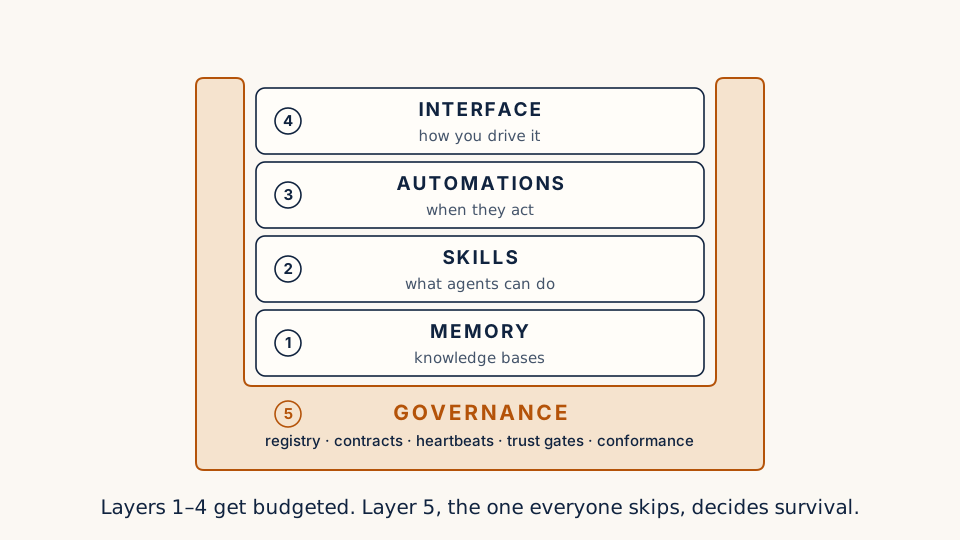
Choosing the right model matters. So does governance: what agents may do, who checks them, and whether your controls would survive an independent audit. But neither is the whole problem. Building one is a transformation problem, wider than the technology. Your AI ambitions have to line up with the business strategy. Your workflows have to be redesigned around agents, not just handed new tools. Your IT architecture has to be ready to carry them. Your people need real skills for the change, not just leadership optimism. And your data has to be trustworthy enough for an agent to act on it. None of these is optional, and none of them is a purchase. That is why it is a journey.
If you forward one section of this page to a colleague, make it this one.
Now watch it change.
The same loose pieces, pulled into one operating organisation.
Strategy, governance, workflows, architecture, people, data. One journey.
Agents answer from the brain, with bylines and review dates, so every answer can be checked. People certify what matters and retire what is stale.
Gaps show up as a register, not as a surprise in a meeting. The loop is small, regular and boring. Boring is the point.
This system exists. We run our own practice on one, end to end.
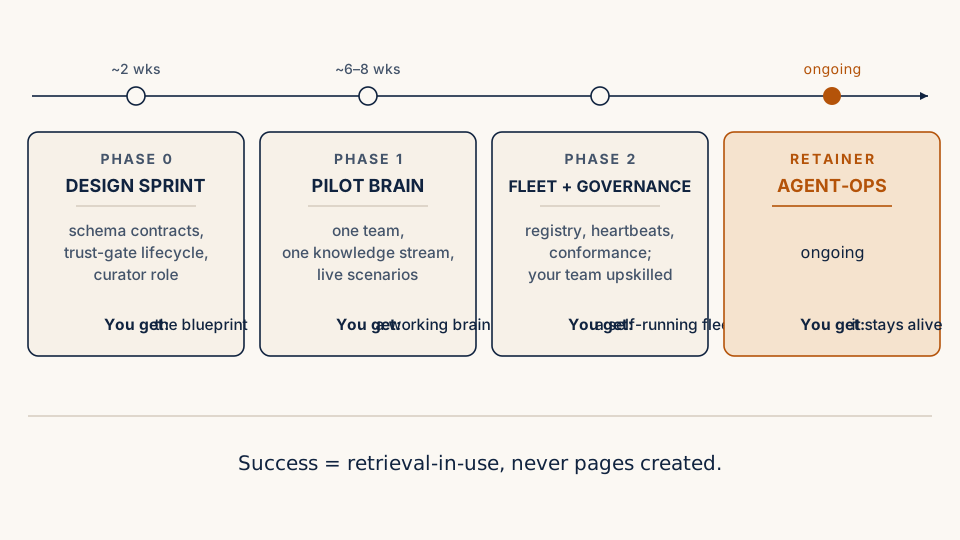
Four shapes, in the order most organisations take them. We stay with you for the whole journey, from strategy alignment to the day the organisation runs on it. No pricing on this page: each engagement is a fixed fee, agreed before we start.
Free, on this site, twelve questions, five minutes. You score yourself; the result tells you where your organisation actually is on the arc.
Half a day with your leadership team. We decide what AI may do in your organisation, what it may not, which models to trust with what, and what to stop pretending about. The fastest paid start.
Two to three weeks inside your organisation: where knowledge actually lives, what is agent-usable today, a readiness score you can defend, and a staged roadmap. The roadmap doubles as the proposal for whatever comes next.
A monthly embedded retainer. The company brain build and the autonomous-org work are delivered under it, in the order the audit’s roadmap set.
No LinkedIn automation. No body-shop implementation teams. No tool reselling. If what you need is any of those, we will say so on the first call and point you elsewhere.
Five practitioners. No names on this page, on purpose. Profiles and introductions are shared on the first call.
Founding practitioner. Enterprise AI architect, PhD, fifteen years across large-scale enterprise and applied research. Auckland and the GCC.
Academic partner. Career researcher in machine learning and applied AI, widely published, active in both research and industry deployment.
Strategy partner, Riyadh. Two decades across government and enterprise technology programmes in the Gulf.
Delivery partner, New Zealand. Enterprise systems and integration background across regulated industries.
Engineering partner, New Zealand. Applied AI and data engineering across production systems.
Enterprise leaders: start with the assessment, then the intensive.
GCC leaders: start with the intensive. We work in the region; Arabic materials are on the way.
Essays and frameworks land here from September: what a company brain is made of, why your pilot failed on the substrate, and how an organisation actually runs on one. Subscribe below and they arrive by email, monthly at most.
The Second Workforce · Auckland
If any of this sounded like your organisation, take the five-minute assessment, or write to info@thesecondworkforce.com.
Subscribe: essays by email, monthly at most. Unsubscribe is one reply.